Blake Roth · 13 October 2026
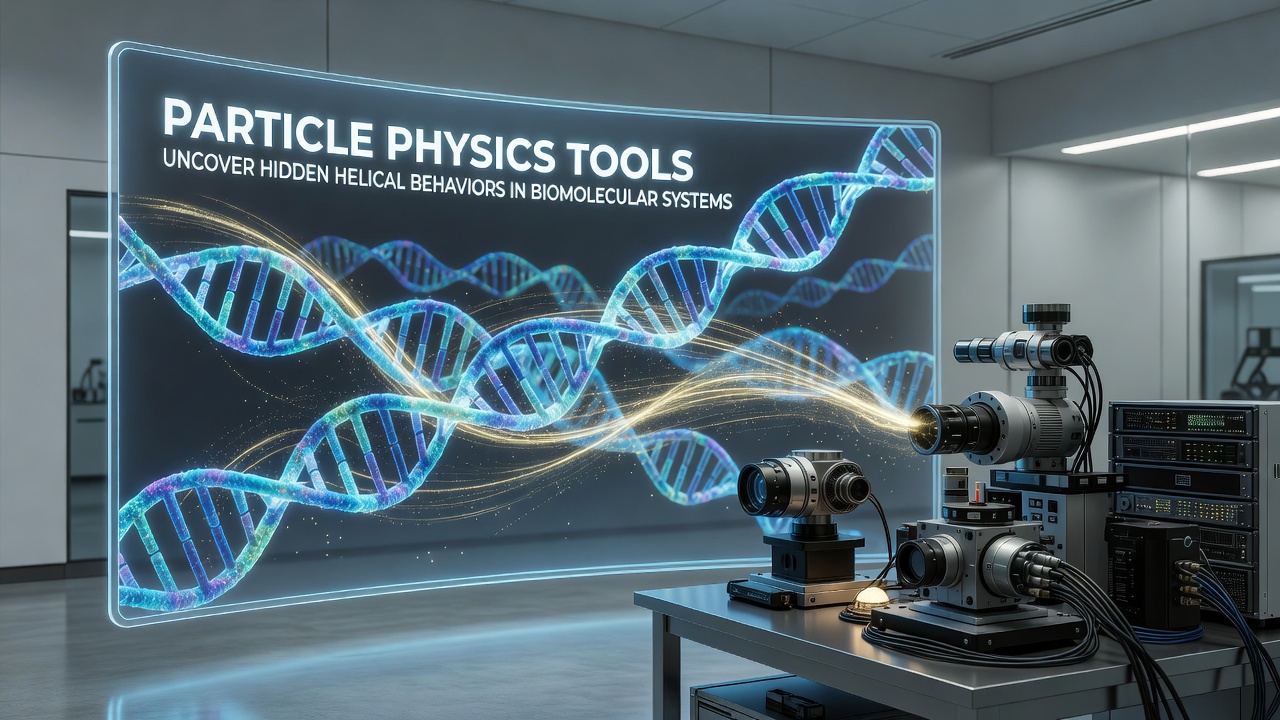
Particle Physics Tools Uncover Hidden Helical Behaviors in Biomolecular Systems
Researchers have applied particle physics instrumentation and data analysis methods to biomolecular systems where they detect previously unobserved helical dynamics in proteins and nucleic acids, and these approaches combine high-energy scattering techniques with advanced computational frameworks originally developed for collider experiments.
Particle accelerators generate intense beams that allow scientists to probe molecular structures at atomic resolution while synchrotron facilities produce X-ray pulses capable of capturing transient helical conformations in real time, and data processing pipelines borrowed from high-energy physics experiments filter noise from the resulting diffraction patterns with remarkable precision.
Core Techniques Transferred from Particle Physics
Teams at major laboratories have adapted muon tomography setups and silicon tracker arrays to monitor biomolecular samples in solution, whereas traditional optical methods often miss rapid helical unwinding events that occur on picosecond timescales, yet these particle-derived sensors register positional shifts through charged particle interactions that reveal the underlying geometry.
Computational models trained on LHC collision datasets now simulate solvent interactions around alpha helices and DNA coils, and algorithms designed to reconstruct particle trajectories handle the stochastic movements of atoms within crowded cellular environments where conventional molecular dynamics software struggles with scale.
Recent Observations in Protein and DNA Systems
Studies conducted through 2025 documented helical breathing modes in membrane proteins that alternate between compact and extended states, and these fluctuations influence ion channel gating according to measurements taken at facilities equipped with particle physics-grade timing electronics.
One research group tracked a bacterial enzyme whose catalytic helix rotates in discrete steps synchronized with substrate binding, while the detection system resolved angular displacements smaller than one degree using position-sensitive detectors originally engineered for vertex reconstruction in collider environments.
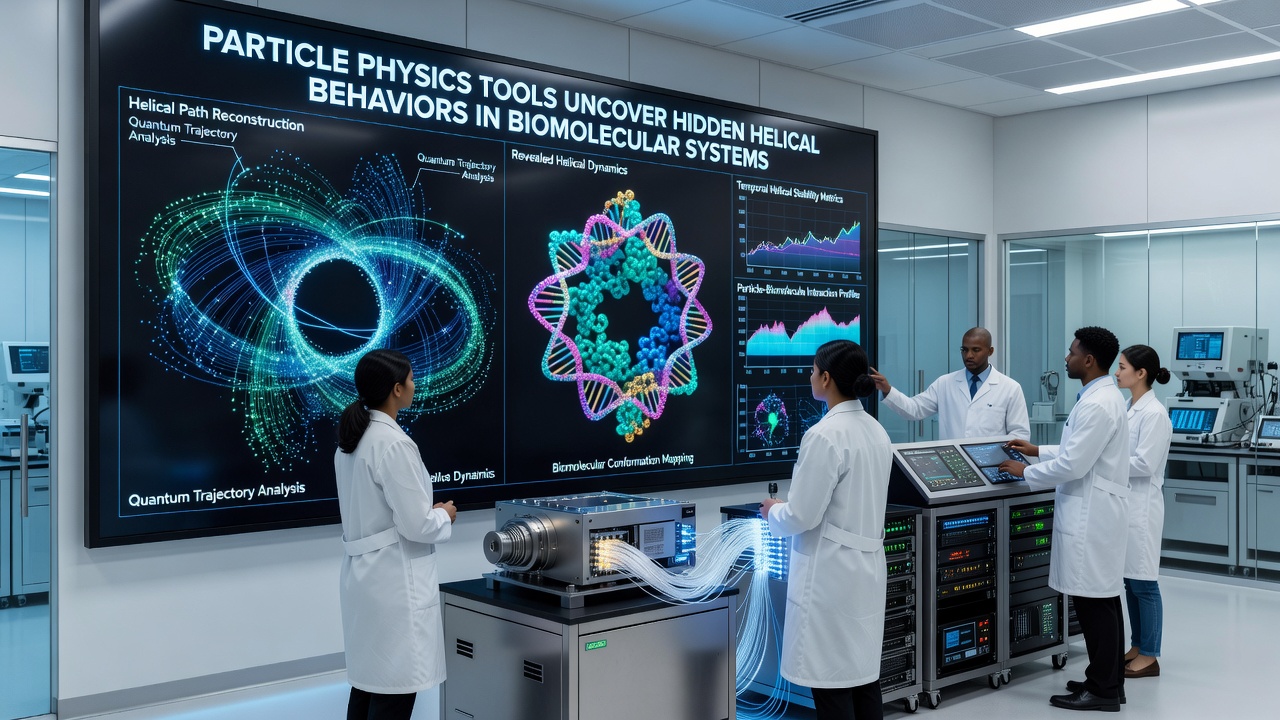
Evidence from neutron scattering runs at international facilities shows that hydration shells around DNA helices reorganize in coordinated waves rather than randomly, and the patterns align with predictions from quantum chromodynamics-inspired statistical mechanics applied to biomolecular contexts.
Integration with Existing Biological Research Frameworks
Collaborations between high-energy physics divisions and structural biology departments have produced hybrid instruments that combine cryo-electron microscopy stages with fast readout chips developed for tracking experiments, and these setups record helical domain movements during protein folding pathways without requiring chemical fixation that might alter native states.
Data shared through open repositories indicate that certain ribosomal helices exhibit cooperative twisting motions during translation that depend on magnesium ion concentration, while analysis pipelines refined through years of particle collision statistics identify rare conformational substates that influence overall efficiency.
Workshops scheduled for October 2026 will focus on standardizing these cross-disciplinary methods so that laboratories worldwide can apply consistent calibration protocols when examining helical motifs in viral capsids and chromatin fibers.
Broader Implications for Structural Analysis
Application of these tools extends to synthetic biology where engineered helical bundles serve as scaffolds for nanoscale devices, and researchers report improved characterization of stability under varying thermal conditions thanks to the sensitivity of particle physics detectors to low-amplitude oscillations.
According to reports from the National Institutes of Health, integration of collider-style event reconstruction has accelerated identification of helical defects linked to misfolding diseases in model systems.
European facilities have contributed complementary datasets from polarized neutron experiments that map magnetic signatures of electron delocalization along helical backbones, whereas North American synchrotron upgrades provide higher flux beams suited for time-resolved studies of larger complexes.
Conclusion
Particle physics tools continue to expand the observable range of helical behaviors across biomolecular systems by supplying both hardware adn analytical methods that surpass conventional limits in temporal and spatial resolution, and ongoing exchanges between the two fields support further refinement of experimental designs for the coming years.